

Most trading losses are not caused by a bad strategy — they are caused by what happens between the strategy and the click. This practical guide shows you how to improve your trading psychology with concrete exercises for emotional control, discipline, patience, and self-awareness.
Why trading psychology matters more than most traders think
Ask a room of struggling traders what is holding them back and most will say their strategy. Ask a room of consistently profitable traders the same question and you will hear a different answer: mindset, discipline, and emotional control.
The uncomfortable truth is that most traders do not lose because they cannot read a chart. They lose because they cannot execute what they already know. They move stop losses, chase entries, oversize after a win, revenge trade after a loss, and abandon good plans the moment fear or greed shows up. That gap — between knowing and doing — is trading psychology.
The good news: trading psychology is not a personality trait you either have or you do not. It is a set of skills — awareness, discipline, patience, emotional regulation — that can be trained deliberately, the same way you trained chart reading. This guide walks through how to do that, step by step.
Understand what trading psychology actually is
Trading psychology is the collection of emotions, biases, habits, and beliefs that influence your decisions before, during, and after a trade. It shows up in three places:
- Before the trade — hesitation on valid setups, FOMO on invalid ones, over-preparation as a way to avoid pulling the trigger.
- During the trade — watching every tick, moving stops, taking profits early out of fear, adding to losers out of hope.
- After the trade — replaying losses, attaching self-worth to outcomes, and letting the last result distort the next decision.
Improving your trading psychology means working on all three phases, not just trying to feel calmer while a position is open.
Step 1: Build awareness before you try to change anything
You cannot fix a pattern you have not seen. The first skill of trading psychology is simply noticing what you feel and do, without judging it.
Start a reflection habit
After each session, write down three things:
- What emotion was strongest today — fear, greed, frustration, boredom, euphoria?
- Where did it show up in my decisions?
- What did I do well, regardless of profit or loss?
This takes five minutes. Do it for a few weeks and you will start to see recurring loops: the same emotion, the same trigger, the same mistake. Those loops are your real trading system — the one running underneath your strategy.
Name the emotion in real time
A surprisingly effective in-the-moment technique: when you feel the urge to do something impulsive, silently label the emotion. "This is fear of missing out." "This is anger from the last loss." Labelling an emotion creates a small gap between feeling and action — and that gap is where discipline lives.
Step 2: Control what you can before the session starts
Emotional control is much easier when you reduce the number of decisions you make under pressure. Professionals do this with pre-commitment.
- Define your setup criteria in writing. If you cannot describe a valid entry in two sentences, every chart will look like an opportunity.
- Set a daily loss limit before the open. Decide, while calm, the point at which you stop for the day. Then honour it like a contract.
- Decide position size by rule, not by feeling. Sizing up because you "feel confident" is how one bad day erases a good month.
- Run a pre-trade checklist. A short checklist — is this my setup, is my risk defined, am I emotionally neutral? — filters out the majority of impulsive trades before they happen.
Step 3: Train discipline and impulse control deliberately
Discipline is not willpower. Willpower runs out by lunchtime. Discipline is the result of structure, small commitments, and repetition.
Shrink the battlefield
If breaking rules is your pattern, trade smaller — small enough that the outcome barely matters financially. At that size, following your rules becomes easy, and you can rebuild the habit of rule-following without the emotional noise of meaningful money. Scale back up only after a sustained stretch of disciplined execution.
Use the ten-second pause
Before entering any trade that was not planned in advance, wait ten seconds and ask: "Would I take this trade if I had just come back from a walk?" Most impulse trades fail that test. The ones that pass were probably valid setups anyway.
Grade your execution, not your P&L
At the end of the week, score each trade on process: did I take my setup, at my size, with my stop and target? A week of losing trades executed perfectly is a good week. A winning week full of broken rules is a warning. Traders who grade process improve; traders who grade only profit repeat their mistakes.
Step 4: Work on patience — the most underrated edge
Boredom is one of the most expensive emotions in trading. It manufactures trades out of nothing. Patience is not passive waiting; it is an active decision to let the market come to you.
- Limit your trade count. A maximum number of trades per day or week forces selectivity.
- Set alerts instead of staring. Watching price tick by tick creates the illusion that you should be doing something. Alerts let you step away until your level is reached.
- Keep a "trades I skipped" note. Writing down the trades you did not take — and how they turned out — teaches you, with your own data, how often doing nothing was the profitable choice.
Step 5: Fix revenge trading and loss spirals at the root
Revenge trading — jumping straight back in to win back a loss — is not a strategy problem. It is your brain treating a financial loss like a threat that must be answered immediately. If this is a recurring pattern for you, we wrote a full practical guide on how to stop revenge trading, but the core moves are:
- Mandatory cool-down. After a loss beyond a set size, step away from the screen for a fixed period — fifteen minutes minimum.
- One-loss-then-review rule. After a stopped-out trade, you may not re-enter the same instrument without writing down what changed.
- Reduce size after losses, never increase it. The urge to size up after a loss is the single fastest route from a bad trade to a bad month.
Step 6: Review like a professional
Improvement comes from structured review, not from screen time alone. Once a week, set aside thirty to sixty minutes to look at your behaviour, not just your charts:
- Which rules did I break, and what was I feeling in that moment?
- Which emotion cost me the most this week?
- What is the single behavioural change I will focus on next week?
One change at a time. Trying to fix discipline, patience, and impulse control simultaneously usually means fixing none of them. Pick the highest-cost pattern, work on it for a month, then move to the next.
For a practical routine you can apply immediately, see our guide on building trading discipline with daily habits.
How long does it take to improve trading psychology?
Longer than a weekend, shorter than you fear — if you work on it deliberately. Most traders who commit to structured reflection, pre-commitment rules, and weekly behavioural reviews report noticeable changes in their decision quality within a few months. The key word is deliberate: passive experience alone mostly teaches you to repeat your existing habits with more confidence.
Common mistakes when working on trading psychology
- Treating it as motivation, not skill. Watching an inspiring video feels like progress. It is not. Progress is a written checklist you actually used today.
- Only reviewing after losses. Your winning trades contain broken rules too — they just got paid anyway. Those are the habits that hurt you later.
- Confusing calm with control. You will still feel fear and greed. The goal is not to eliminate emotion; it is to prevent emotion from making decisions.
- Changing strategy instead of behaviour. If you keep switching systems after every losing streak, you will never know whether the problem was the strategy or the execution. Usually it is the execution.
Measure yourself honestly
Most traders overestimate their discipline and underestimate how much their emotions drive their decisions. An honest baseline makes progress visible and tells you which of the areas above deserves your attention first.
Our free Trading Psychology Test scores you across five areas — discipline, emotional control, impulse control, patience, and rule adherence — and gives you a practical interpretation of your result. It takes about three minutes and stores nothing.
The bottom line
Improving your trading psychology is unglamorous work: a checklist before the trade, a pause before the click, five minutes of honest writing after the close, and a weekly review of your own behaviour. None of it is exciting. All of it compounds.
Your strategy tells you what to trade. Your psychology decides whether you actually do it. Train the second one with the same seriousness you gave the first, and consistency stops being a mystery.
---
TradeSthira is being built around exactly this idea: trading psychology, emotional awareness, and discipline as trainable daily skills. This article is for education only and is not financial advice. Trading involves risk, including the possible loss of capital.
Related Resources

How to Stop Revenge Trading: A Practical Guide for Traders
Revenge trading can turn one manageable loss into a damaging trading session. Learn how to recognise the warning signs, interrupt the cycle and build a more disciplined response to losing trades.
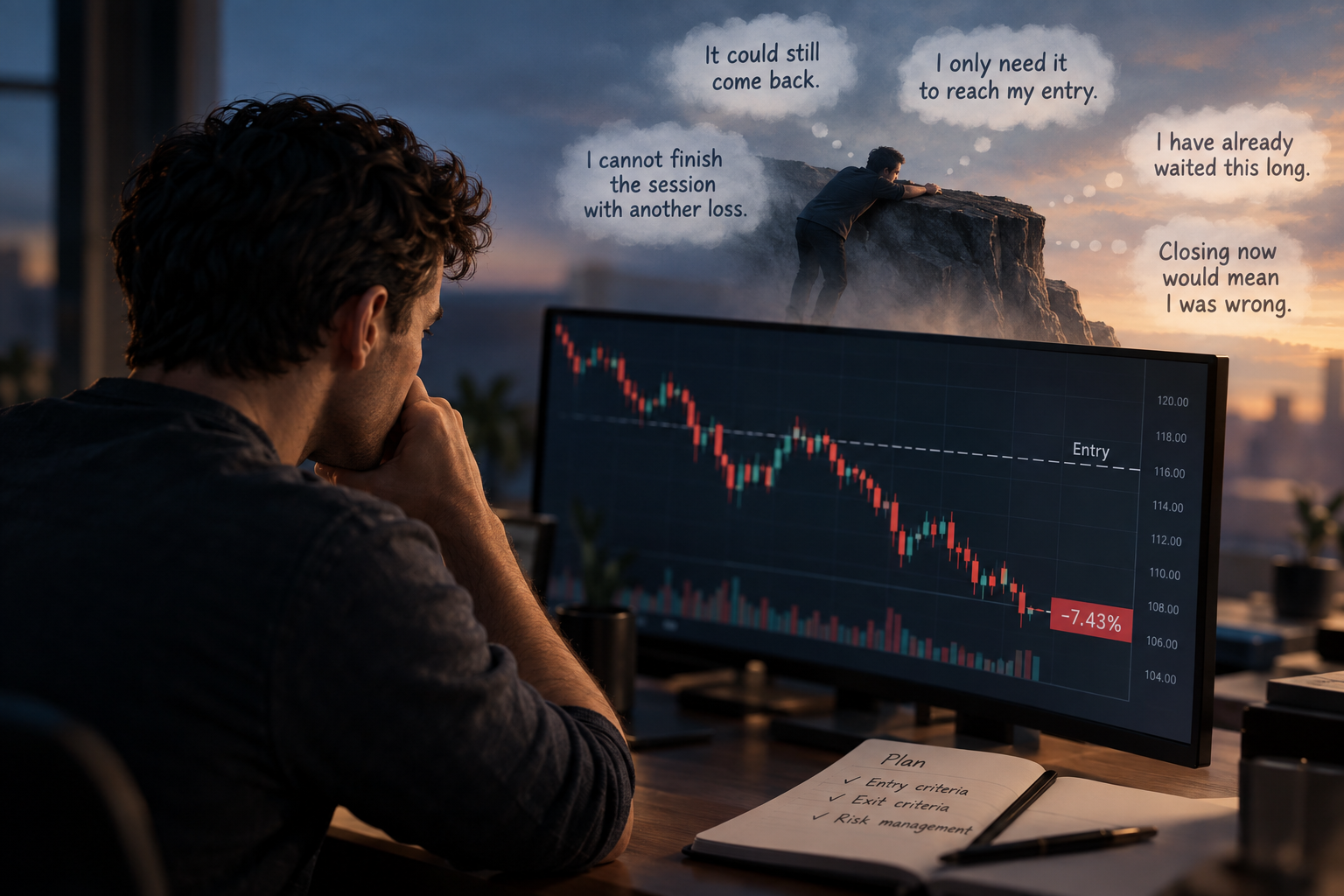
Loss Aversion Trading Traps: Why Holding Losers Feels Safer
Holding a losing trade can preserve hope while postponing the discomfort of accepting a loss. Learn how to recognise that emotional bargain and keep your decision-making anchored to a process.
How to Build Trading Discipline: 8 Habits for More Consistent Trading
Trading discipline isn't about eliminating emotion or following rules blindly. Learn 8 practical habits that can help traders build a more consistent decision-making process.