
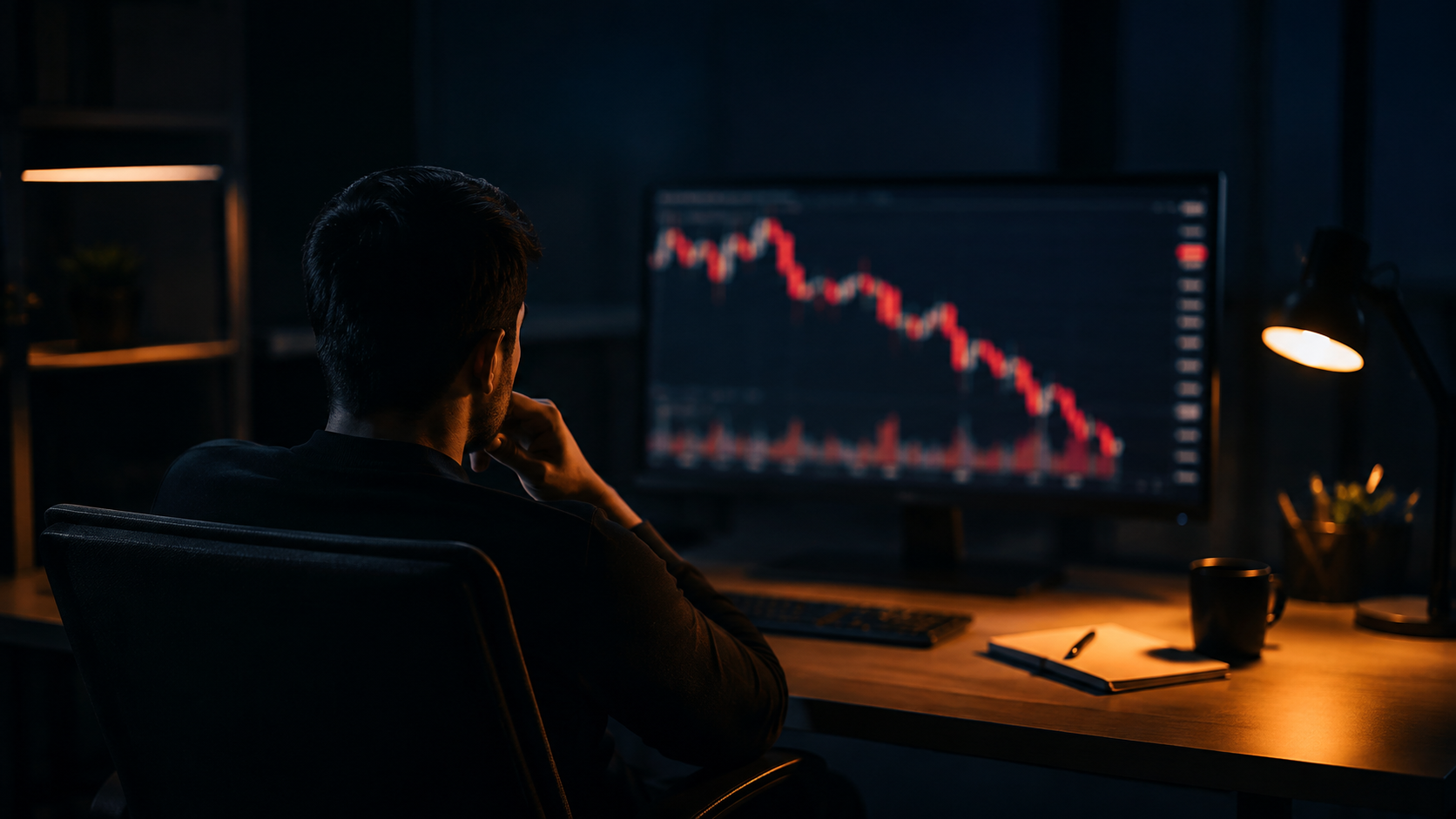
Revenge trading can turn one manageable loss into a damaging trading session. Learn how to recognise the warning signs, interrupt the cycle and build a more disciplined response to losing trades.
A losing trade is part of trading.
What happens immediately after it can be far more important.
You take a loss. You feel frustrated. Another opportunity appears and suddenly the urge to get back into the market feels unusually strong.
The next trade may look like another setup.
But sometimes it isn't.
Sometimes you're no longer trading the market in front of you. You're trading the need to recover what you just lost.
That's revenge trading.
What is revenge trading?
Revenge trading is the tendency to take impulsive, poorly planned or unnecessarily aggressive trades after experiencing a loss.
The objective quietly changes.
Instead of asking:
"Does this trade meet my setup?"
the trader begins thinking:
"How can I make that money back?"
That shift can happen surprisingly quickly.
A trader who was patient five minutes earlier may suddenly enter a marginal setup, increase position size, ignore a rule or take another trade without waiting for confirmation.
The market hasn't necessarily changed.
The trader's mental state has.
Why does revenge trading happen?
Losing money creates an emotional response.
For some traders that response is disappointment. For others it can be frustration, embarrassment, anger or urgency.
The brain naturally wants to remove that discomfort.
In trading, one seemingly obvious way of doing that is to win the money back.
This creates a dangerous feedback loop:
Loss → frustration → urgency → lower-quality decision → another loss → greater frustration.
The larger the emotional response becomes, the harder it can be to objectively evaluate the next setup.
This is why revenge trading isn't simply a strategy problem.
It's also a behavioural problem.
7 signs you may be revenge trading
Revenge trading doesn't always look dramatic.
Sometimes it appears through small changes in behaviour.
Watch for these warning signs:
- You enter another trade unusually quickly after taking a loss.
- You're thinking about recovering the previous loss rather than evaluating the next setup independently.
- You increase your normal position size without a planned reason.
- You accept a setup that you would normally reject.
- You skip part of your normal pre-trade process.
- You feel unusually impatient waiting for confirmation.
- You continue trading primarily because you don't want to finish the session negative.
One useful question can expose the problem:
If the answer is no, your previous loss may be influencing your current decision.
How to stop revenge trading
You don't need to eliminate emotion from trading.
That's unrealistic.
The goal is to prevent an emotional response from automatically becoming a trading decision.
Here are seven practical ways to do that.
1. Create a mandatory pause after a loss
Don't immediately search for another trade.
Create a predefined interruption between the loss and your next decision.
That could mean:
- stepping away from the screen
- getting some water
- taking a short walk
- waiting for the next candle
- reviewing the losing trade
- completing a mental check-in
The exact length of the pause matters less than its purpose.
You're creating distance between emotional reaction and execution.
2. Reset the next trade to zero
Your next trade does not owe you the money you just lost.
Treat it as an entirely new decision.
The previous P&L should not determine:
- whether you enter
- how much you risk
- where you enter
- where your stop goes
- whether the setup is valid
Ask yourself:
"Would I still take this exact setup if I were starting the day at zero?"
If not, stop and reassess.
3. Use a pre-trade checklist
A checklist creates friction between impulse and execution.
Before entering, confirm the things that should objectively be true for your strategy.
For example:
- Is my setup actually present?
- Is the entry valid?
- Is my stop defined?
- Is the risk acceptable?
- Am I following my normal position-sizing rule?
- Is this trade part of my plan?
- Am I emotionally ready to take another trade?
A checklist won't guarantee a winning trade.
That's not its purpose.
Its purpose is to increase the probability that the trade you're about to take is intentional.
4. Set a maximum loss or stop rule before trading
Decisions made before emotions become elevated are often better than decisions made afterwards.
Define in advance what causes you to stop.
That could be:
- a maximum daily loss
- a maximum number of losing trades
- a maximum number of trades
- a specific emotional threshold
- repeated rule violations
Once the threshold is reached, the decision has already been made.
The trading session ends.
5. Check your mental state, not just the chart
Before entering another trade after a loss, ask yourself:
- Am I frustrated?
- Am I trying to recover money?
- Do I feel rushed?
- Am I afraid of missing the next move?
- Would I be comfortable not trading for the next 30 minutes?
- Am I following my process or reacting to my P&L?
This kind of mental check-in is one of the ideas behind TraderMynd.
Markets provide endless information about price.
Traders also need a way to pay attention to the person making the decision.
6. Separate a good trade from a winning trade
A profitable trade can still be poorly executed.
A losing trade can still be well executed.
Suppose you followed your setup, respected your risk, entered correctly and honoured your stop.
The trade lost.
That doesn't automatically make it a bad trade.
Conversely, suppose you ignored your rules, doubled your position and impulsively entered — but happened to make money.
That doesn't automatically make it a good trade.
If you judge every decision purely by P&L, revenge trading becomes easier to justify.
Instead, evaluate both:
Outcome
and
Process.
7. Review the behaviour after the session
Your trading journal shouldn't only tell you what happened to the market.
It should help you understand what happened to you.
After the session, record things such as:
- What triggered the revenge-trading urge?
- What emotion did you notice?
- Did you follow your normal setup?
- Did your position size change?
- Did you respect your stop?
- Did you follow your checklist?
- What would you do differently next time?
Over time, patterns start becoming visible.
Perhaps revenge trading happens most often after your first loss.
Perhaps it happens after a large unrealised profit disappears.
Perhaps it happens when you're already tired or frustrated.
Recognising the pattern makes it easier to interrupt.
Build a revenge-trading circuit breaker
One of the simplest approaches is to create a predetermined sequence.
For example:
Loss occurs
→ Step away from the chart
→ Record the trade
→ Rate your emotional state
→ Recheck your setup criteria
→ Complete your pre-trade checklist
→ Only then decide whether another trade is justified
Notice the final step.
It isn't:
"Take another trade."
It's:
"Decide whether another trade is justified."
Sometimes the best next trade is no trade at all.
The goal isn't perfect emotional control
Trading discipline doesn't mean never feeling frustrated.
It doesn't mean becoming emotionless.
And it doesn't mean every disciplined trade will make money.
The goal is much simpler:
Recognise when your state of mind is beginning to influence your execution and create enough structure to prevent that feeling from automatically becoming a trade.
A losing trade is one event.
Revenge trading can turn it into a sequence.
Breaking that sequence is where discipline begins.
Related Resources

How to Improve Trading Psychology: A Practical Guide for Traders
Most trading losses are not caused by a bad strategy — they are caused by what happens between the strategy and the click. This practical guide shows you how to improve your trading psychology with concrete exercises for emotional control, discipline, patience, and self-awareness.
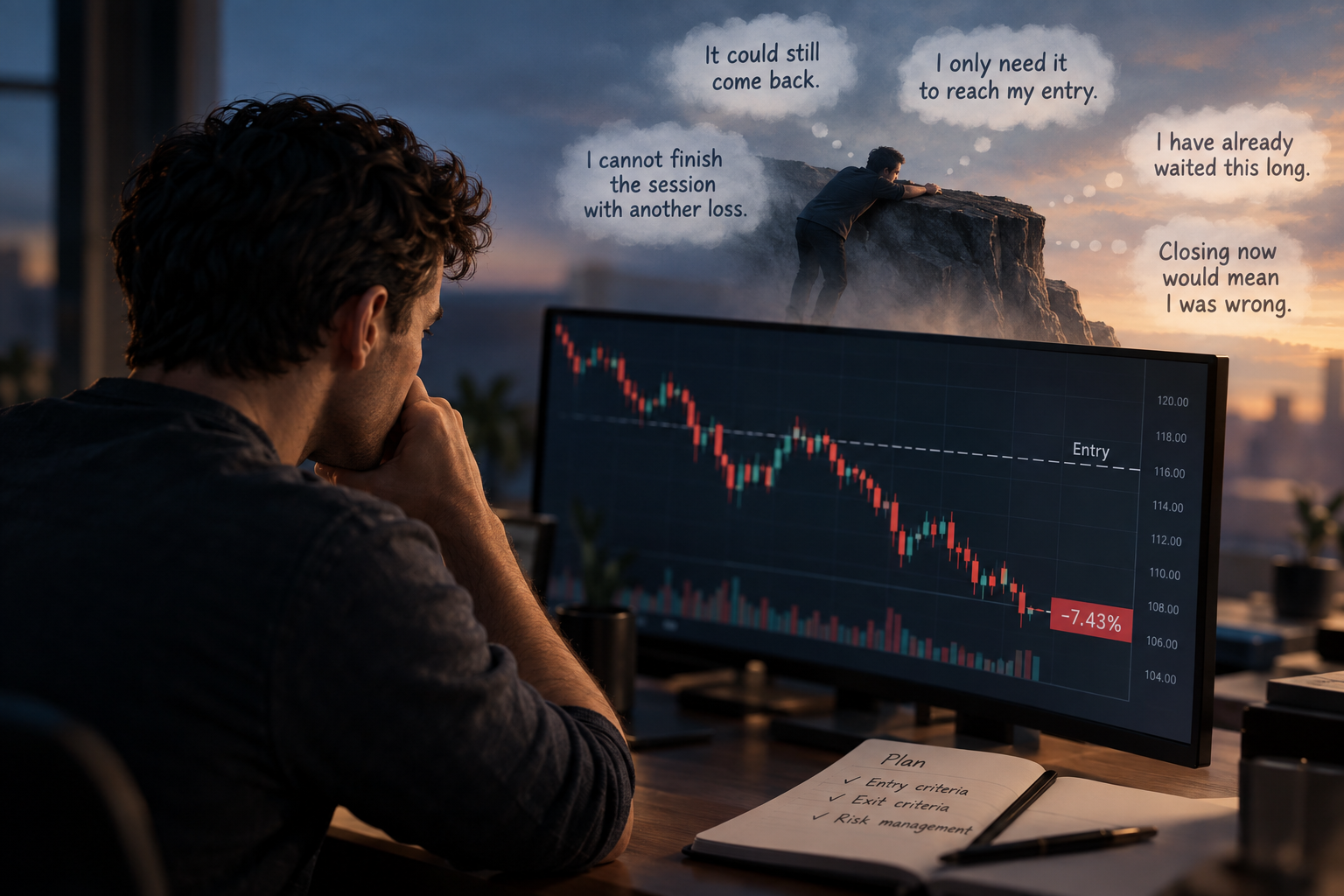
Loss Aversion Trading Traps: Why Holding Losers Feels Safer
Holding a losing trade can preserve hope while postponing the discomfort of accepting a loss. Learn how to recognise that emotional bargain and keep your decision-making anchored to a process.
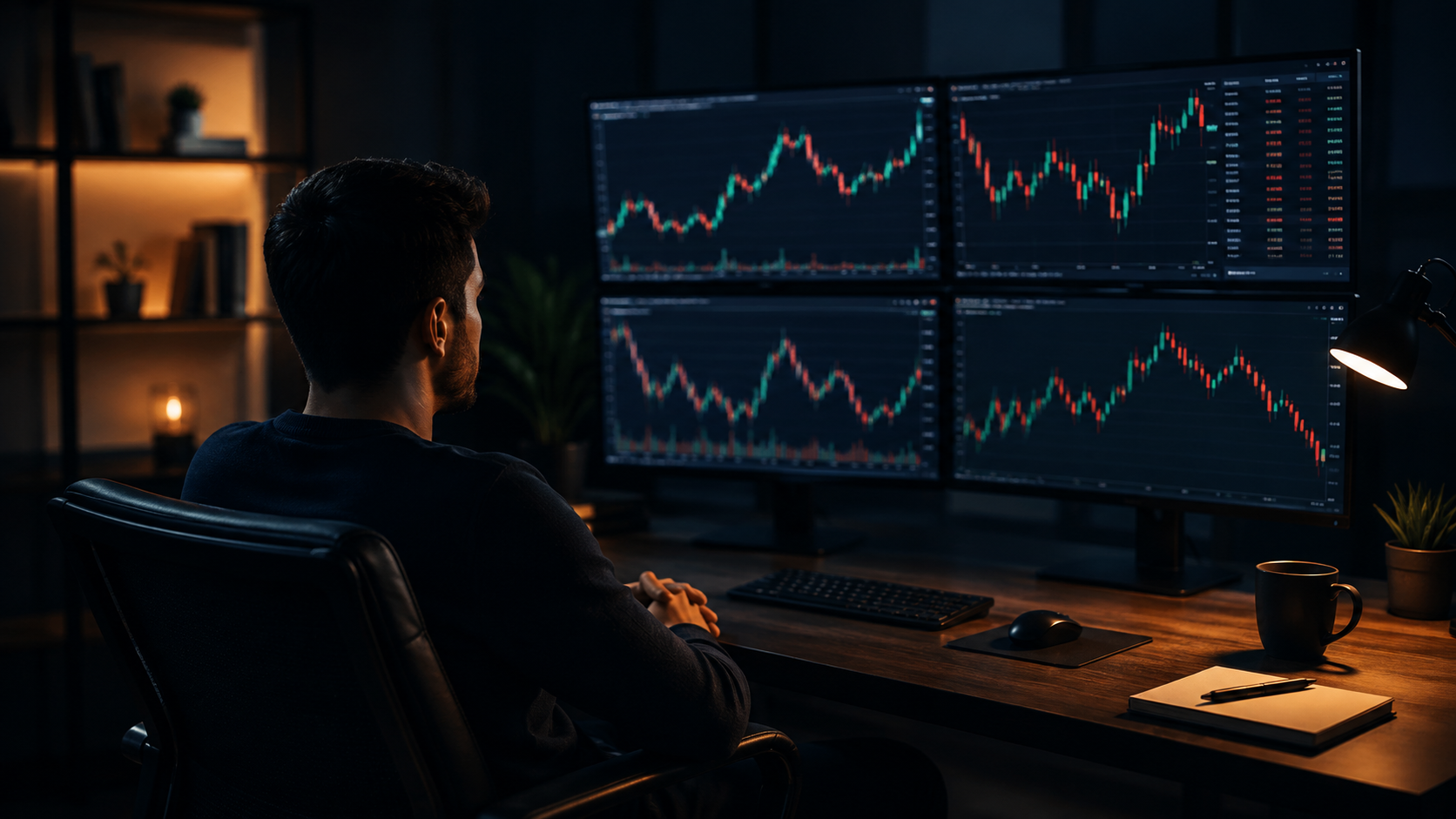
How to Build Trading Discipline: 8 Habits for More Consistent Trading
Trading discipline isn't about eliminating emotion or following rules blindly. Learn 8 practical habits that can help traders build a more consistent decision-making process.