
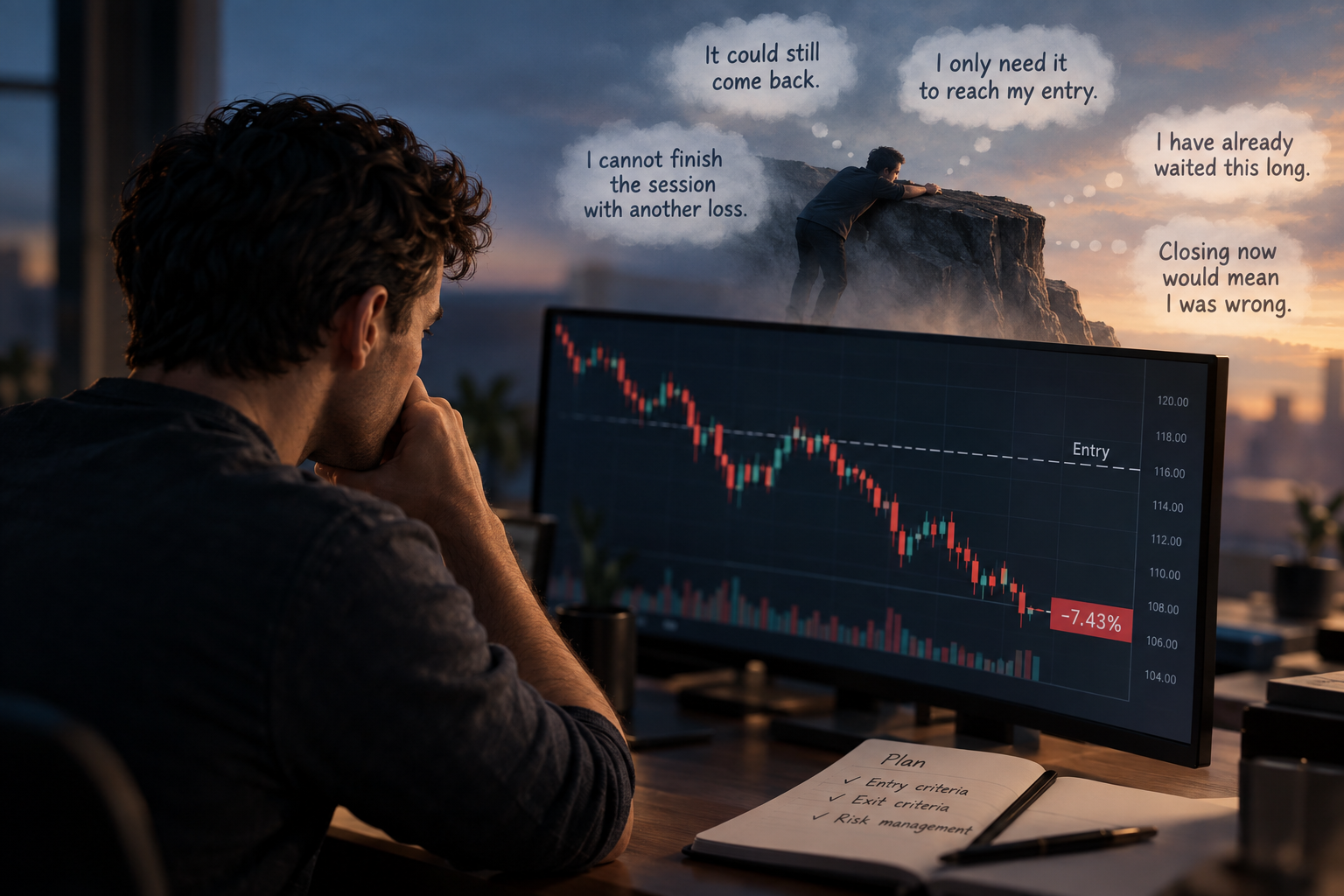
Holding a losing trade can preserve hope while postponing the discomfort of accepting a loss. Learn how to recognise that emotional bargain and keep your decision-making anchored to a process.
Loss aversion trading patterns emerge when the discomfort of accepting a loss starts to outweigh the reasons behind a trade. Holding a losing position can feel safer because it keeps recovery possible and delays the moment when you have to acknowledge the loss. That feeling is emotional relief, not evidence that the position is safer.
The useful response is not to force yourself to stop caring about losses. It is to recognise when avoiding discomfort has become the goal, then return to a decision process established before that discomfort appeared. A losing trade is not automatically a mistake, and holding one is not automatically loss aversion. The key question is whether your reasoning has changed because the evidence changed—or because accepting the loss feels unbearable.
Why an open loss can feel easier to tolerate
An open loss leaves room for a comforting story: “It could still come back.” Closing the trade can feel like turning a possibility into a verdict.
That distinction can become psychologically powerful even though an unrealised loss already affects the value of your position. Keeping the trade open does not remove the exposure or make the original decision more sound.
Your entry price may also become an emotional reference point. Instead of assessing what is happening now, you start organising your thinking around getting back to where you began.
Common thoughts include:
- “I only need it to reach my entry.”
- “I cannot finish the session with another loss.”
- “Closing now would mean I was wrong.”
- “I have already waited this long.”
These thoughts are understandable. But they concern relief, identity or time already spent—not necessarily the conditions that justified the trade.
Recognising loss aversion trading patterns
Loss aversion is not simply disliking losses. Most people dislike them. The problem appears when that dislike changes how you interpret information or apply your own rules.
Your explanation changes after the trade moves against you
Before entry, you had a clear reason for participating and conditions under which that reasoning would no longer apply. Afterwards, those conditions become negotiable.
A short-term idea becomes a longer-term hold. An exception appears that was never part of the plan. You search for reassuring commentary while dismissing information that challenges your position.
A changed view can be legitimate. The warning sign is a change that consistently gives a losing trade more room, without a clear explanation beyond needing it to recover.
You use different standards for gains and losses
You may feel eager to secure a small gain but reluctant to acknowledge a comparable loss. The profitable position feels like something to protect; the losing position feels like something to rescue.
This pattern is often described as the disposition effect: a tendency to realise gains more readily than losses. Loss aversion can contribute to it, although it is not the only possible explanation.
One trade cannot establish a behavioural pattern. Look for repeated differences between your stated process and what you actually do.
Your attention narrows to breaking even
You stop asking whether the original reasoning remains valid. Instead, you calculate how little movement you need to feel relieved.
Repeatedly checking profit and loss, bargaining with the screen and imagining the satisfaction of escaping without a loss can all signal this shift. Your attention is now serving the wish to undo an outcome rather than assess a decision.
Is it loss aversion or reasonable patience?
Not every uncomfortable hold is irrational. Some trading approaches involve tolerating fluctuations, and responding impulsively to every adverse move can also undermine a process.
The distinction is not whether the trade is currently profitable. It is whether your behaviour remains consistent with the approach you chose beforehand.
Consider these questions:
- Was this situation anticipated in my original plan?
- Am I applying criteria that existed before I saw the loss?
- What new information, if any, explains my changed view?
- Would I accept this explanation when reviewing someone else’s decision?
- Is my reasoning about the trade, or about avoiding how a loss would make me feel?
These questions do not tell you whether to hold or exit. They help reveal whether your explanation is stable or being rewritten under pressure.
If you routinely renegotiate clear intentions once money is involved, why you break your trading plan rules explores that gap in more detail.
Build a response before the discomfort arrives
Trying to reason with yourself at peak frustration is difficult. A more useful approach is to prepare a small behavioural routine while you are calm.
Before trading: name your likely bargaining thought
Write down the phrase that tends to appear when you resist a loss. Make it specific: “I will wait until I am back at entry” is more useful than “I get emotional.”
Then identify the observable behaviour that usually follows. Perhaps you rewrite your rationale, repeatedly adjust an existing boundary or seek opinions until someone agrees with you.
A brief pre-trade check-in might record:
- My current emotional state.
- The conditions already defined in my plan.
- The bargaining thought I am likely to have.
- The action I will use to interrupt reactive decision-making.
That interruption might be reading your original rationale or naming the emotion before making an unplanned change. It should support your established safeguards, not become a reason to delay them.
During trading: separate facts, feelings and urges
When you notice bargaining, distinguish three things:
Fact: “The position has moved against me, and this planned condition has occurred.”
Feeling: “I feel embarrassed and anxious about another loss.”
Urge: “I want to change the rules so I do not have to acknowledge it.”
This does not make the emotion disappear. It prevents the emotion from passing unnoticed as market analysis.
Keep any check-in brief. A complicated exercise can become another form of avoidance, especially if you use it to postpone a decision your process already addresses.
For broader routines that support follow-through, see how to build trading discipline.
After trading: review the decision, not just the result
A trade that recovers can reinforce an unhelpful habit: “Ignoring my rule worked.” A trade managed according to plan can still lose money and feel like failure.
Separate those two dimensions in your review:
- Did I follow the process I intended to follow?
- If I changed it, what evidence supported the change?
- What emotion was strongest at that moment?
- What made the next appropriate process step easier or harder?
The aim is not to reward losses or condemn gains. It is to avoid letting one outcome define the quality of your decision-making.
Look for patterns without labelling yourself
“Loss-averse” is not a fixed identity or a diagnosis. Your behaviour may vary with fatigue, recent results, perceived pressure or how personally invested you feel in being right.
Across several sessions, look for recurring circumstances rather than judging yourself from one difficult trade. You might notice that bargaining appears after consecutive losses, when you are distracted or when you feel you must finish the day positively.
Choose one observable behaviour to work on, such as recording a reason whenever you depart from your original plan. That gives you something concrete to review without demanding perfect emotional control.
You can also use the free trading psychology test as a starting point for reflection, rather than as a diagnosis or verdict on your ability.
Join the TradeSthira early access waitlist
TradeSthira is a pre-launch trading psychology and discipline app being built around check-ins before trading, discipline safeguards during, reflection afterwards and behavioural insights over time. It does not provide financial advice, trading signals or promises of returns.
Join the TradeSthira early access waitlist to follow its development and hear when early access becomes available.
Related Resources

How to Improve Trading Psychology: A Practical Guide for Traders
Most trading losses are not caused by a bad strategy — they are caused by what happens between the strategy and the click. This practical guide shows you how to improve your trading psychology with concrete exercises for emotional control, discipline, patience, and self-awareness.
How to Build Trading Discipline: 8 Habits for More Consistent Trading
Trading discipline isn't about eliminating emotion or following rules blindly. Learn 8 practical habits that can help traders build a more consistent decision-making process.

How to Stop Revenge Trading: A Practical Guide for Traders
Revenge trading can turn one manageable loss into a damaging trading session. Learn how to recognise the warning signs, interrupt the cycle and build a more disciplined response to losing trades.