

Crowd emotion can make someone else’s urgency feel like your own conviction. Learn to separate market narratives from your internal response, with practical checks before, during and after trading.
Market psychology is the collective mood, expectations and behaviour of market participants. Your psychology is your individual response to uncertainty, potential gains, losses and social pressure. The two interact: an excited crowd can make you feel late, while a fearful crowd can make uncertainty feel intolerable. But neither crowd confidence nor your emotional intensity establishes what will happen next.
The practical task is not to become immune to emotion or decode the crowd perfectly. It is to notice when the atmosphere around a market starts changing your decision process. Separating what you observe from what you feel gives you room to follow your own boundaries rather than borrow someone else’s urgency.
Market psychology is context, not a forecast
Markets bring together people and institutions with different objectives, time horizons, information and constraints. There is no single mind behind a price movement. What looks like shared enthusiasm may include speculation, hedging, automated activity and participants acting for entirely different reasons.
Still, social patterns can become visible. Confident narratives spread. Recent outcomes attract attention. People look to others for reassurance when the situation is ambiguous.
This matters because you rarely encounter a market as raw information alone. You encounter it through charts, headlines, notifications, group chats and commentary. Each layer can influence what feels important.
A fast-moving price is an observation. “Everyone knows this will continue” is an interpretation. “I need to act before I miss out” is a personal impulse. Treating those three things as interchangeable is where crowd emotion can begin to steer behaviour.
How someone else’s conviction becomes your urgency
Crowd emotion does not need to persuade you through a careful argument. Sometimes it changes the question you are asking.
Instead of “Does this meet the conditions I set beforehand?”, you start asking “Can I bear watching other people participate without me?” That shift can happen quietly, even when you understand the risks.
Social proof can feel like evidence
Repeated claims can start to feel credible simply because they are familiar. Seeing several accounts express the same view may create an impression of independent agreement, even when they are repeating one another.
The useful distinction is between information that adds something new and repetition that adds emotional weight. More exposure is not necessarily more evidence.
Visible outcomes invite comparison
A screenshot shows an outcome, not a complete decision process. It may leave out earlier losses, the person’s circumstances or the rules they followed or ignored.
Yet comparison often happens before those gaps register. Someone else’s result becomes an imagined result you should have achieved. Missing a move can then feel like losing something that was never yours.
Recent experiences colour the next decision
After a satisfying outcome, a confident crowd may feel validating. After a difficult one, the same crowd may make you feel inadequate or desperate to catch up.
The external message has not changed; your starting state has. That is why checking your own condition matters alongside noticing the surrounding mood.
Separate the observation, the story and the urge
Consider a fictional trader, Maya. She opens a group chat after seeing a sharp price move. Several people are celebrating. She had not planned to participate, but now feels she needs to decide immediately.
Rather than debating whether the group is right, she writes three short lines:
- Observation: The price has moved quickly, and several people in this chat are posting positive outcomes.
- Story: Everyone else understood something I missed. This may be my last chance.
- Urge: Abandon my planned review and act immediately.
This exercise does not tell Maya whether a trade would succeed. It reveals that a social comparison has become part of her decision process.
She can then ask a fourth question: What boundary did I choose before this feeling arrived?
Perhaps her boundary was to finish a pre-session check-in before making any trading decision. Returning to that commitment is a process choice, not a prediction about price.
You can use the same four prompts whenever your thinking suddenly becomes more urgent, absolute or self-critical.
Before trading: identify your points of vulnerability
A useful check-in is brief enough to complete honestly. It should describe your current state, not demand that you feel perfectly calm.
Ask yourself:
- What is my energy and attention like today?
- Am I carrying frustration, excitement or disappointment from an earlier session?
- What am I hoping trading will make me feel: capable, relieved, included or vindicated?
- Which outside source most often makes me rush?
- What existing boundary will I return to if that pressure appears?
Be specific. “Avoid emotion” is too vague to guide behaviour. “If I notice myself scrolling through other people’s results to justify a decision, I will pause and return to my checklist” is observable.
The aim is to reduce improvisation when your attention narrows. For a broader approach to check-ins and reflection, read How to Improve Trading Psychology: A Practical Guide for Traders.
During trading: notice when the process changes
You do not need to monitor every feeling. Look for changes in behaviour that suggest emotion is taking over the process.
Common examples include repeatedly refreshing a feed, seeking only supportive commentary, skipping a normal review or silently rewriting a boundary because the situation feels exceptional.
Use a pause with a clear purpose
A pause is more useful when it has a task attached. Otherwise, it can become a short delay spent rehearsing the same justification.
During the pause:
- Name the trigger without exaggeration: “I saw three celebratory posts.”
- Name the feeling: “I feel excluded and impatient.”
- Identify what changed: “I am now considering something I had not reviewed.”
- Return to your existing decision checklist or session boundary.
This does not guarantee a good outcome. It makes the source of pressure more visible and gives your process a chance to remain intact.
If urgency tends to appear after a loss, comparison may be mixing with a desire to undo discomfort. How to Stop Revenge Trading: A Practical Guide for Traders explores that pattern in more detail.
After trading: review the influence, not just the outcome
An outcome alone cannot tell you whether you maintained your boundaries. A favourable result can follow a rushed decision; an unfavourable result can follow a considered one.
Keep the reflection focused on behaviour:
- What external input had the strongest effect on me?
- What meaning did I attach to it?
- Did my decision process change after that exposure?
- Which safeguard did I use, skip or need to clarify?
- What is one environmental change worth testing next time?
An environmental change could mean muting a distracting group chat during your planned review or separating research time from social browsing. The question is whether the change supports attention and adherence to your own boundaries, not whether it improves returns.
Across several sessions, look for recurring combinations: tiredness plus notifications, a recent loss plus celebratory posts, or boredom plus constant commentary. Treat these as patterns to investigate, not proof of causation from a handful of examples.
Build awareness without giving yourself a label
Being influenced by others does not mean you are weak or unsuited to trading. Equally, recognising the pattern once does not make you immune to it.
The useful skill is noticing earlier and responding more deliberately. If you want a structured starting point, try the free trading psychology test as a prompt for reflection, not a diagnosis or a verdict on your ability.
Join the TradeSthira early access waitlist
TradeSthira is a pre-launch trading psychology and discipline app being built around check-ins before trading, discipline safeguards during sessions, reflection afterwards and behavioural insights over time. It is not primarily a trading journal, and it provides no financial advice, signals or return promises.
Join the TradeSthira early access waitlist to follow its development towards supporting a more deliberate trading process.
Related Resources

How to Improve Trading Psychology: A Practical Guide for Traders
Most trading losses are not caused by a bad strategy — they are caused by what happens between the strategy and the click. This practical guide shows you how to improve your trading psychology with concrete exercises for emotional control, discipline, patience, and self-awareness.

How to Stop Revenge Trading: A Practical Guide for Traders
Revenge trading can turn one manageable loss into a damaging trading session. Learn how to recognise the warning signs, interrupt the cycle and build a more disciplined response to losing trades.
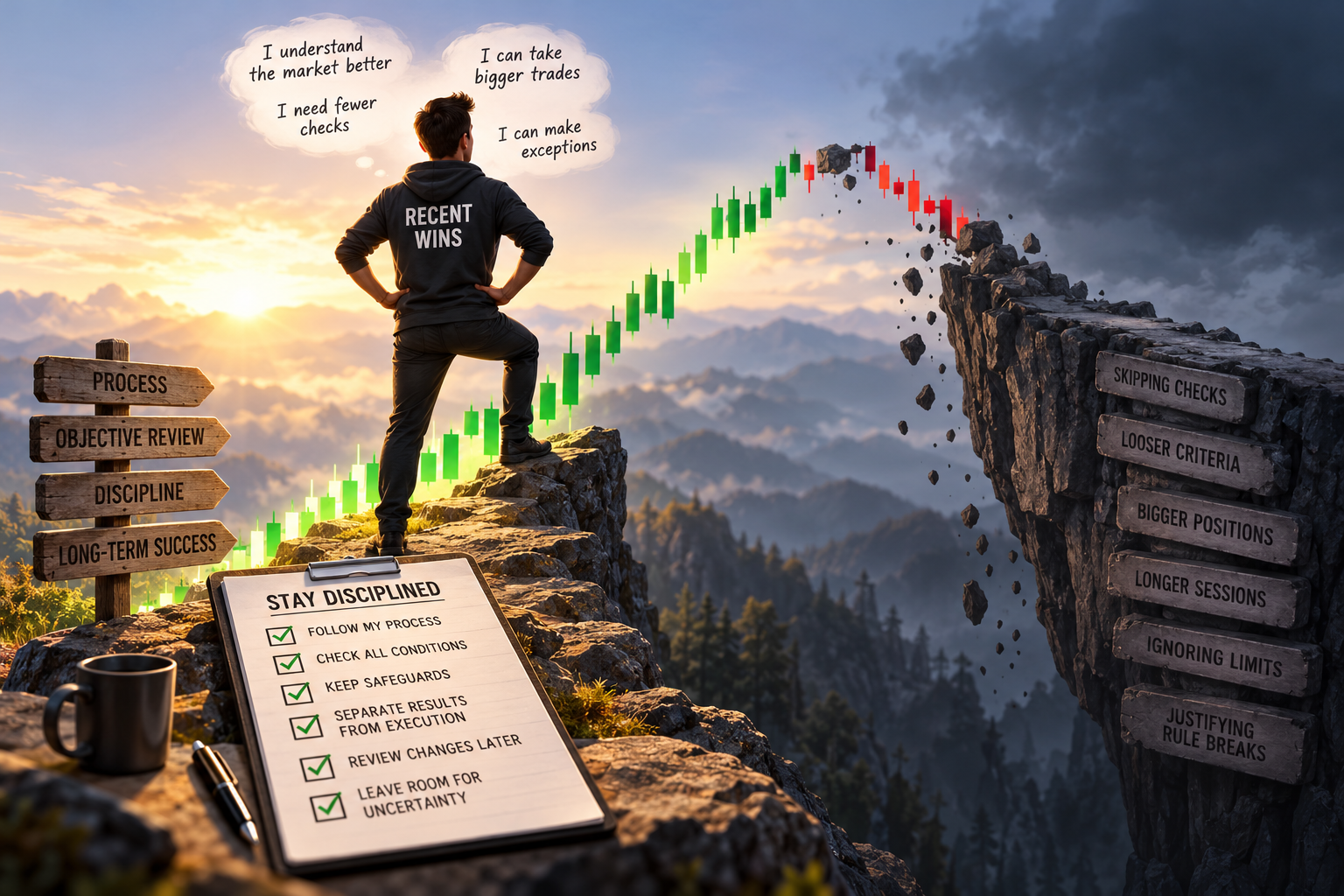
Overconfidence in Trading After a Winning Streak: The Hidden Risk
A winning streak can make your rules feel less necessary precisely when you need them. Learn how to recognise confidence turning into entitlement and keep your process steady.