

A winning streak can make your rules feel less necessary precisely when you need them. Learn how to recognise confidence turning into entitlement and keep your process steady.
Overconfidence in trading happens when your certainty about your judgement exceeds what the evidence supports. After a winning streak, recent profits can start to feel like proof that you understand the market better, need fewer checks or can safely make exceptions. The hidden risk is not feeling pleased with yourself; it is allowing that feeling to change your behaviour without proper review.
The practical response is to separate results from execution. Check whether you followed your process, notice any urge to relax safeguards, and keep decisions about changing your rules outside the excitement of a live session. You do not need to suppress confidence. You need confidence that leaves room for uncertainty.
Why winning can weaken your discipline
A profitable outcome gives clear, immediate feedback. The quality of the decision behind it is harder to judge.
You might follow your plan carefully and finish with a loss. You might ignore an important condition and finish with a profit. If you judge both decisions only by the result, the second experience can teach the wrong lesson: the rule apparently did not matter.
A streak can repeat that lesson until exceptions begin to feel justified. A check that once seemed useful now feels slow. A familiar setup starts to look obvious before you have checked all its conditions.
Recent success may also reflect conditions that happen to suit your approach. That does not make the success meaningless. It means that a short run of outcomes cannot, by itself, tell you how much came from skill, favourable conditions or chance.
The important question is not whether you deserved the wins. It is whether those wins are changing how you make the next decision.
Signs of overconfidence in trading
Healthy confidence and overconfidence can feel similar. Both may involve calmness, decisiveness and less hesitation. The difference becomes clearer in your behaviour.
Confidence still allows for being wrong
Process-based confidence means you can explain your decision, identify uncertainty and accept that a valid decision may not produce the outcome you want.
You still complete your checks when they feel repetitive. You can leave an opportunity alone when it does not meet your criteria. You do not need the next result to confirm your ability.
Overconfidence makes those constraints feel unnecessary. Your certainty becomes a substitute for evidence.
Look for small exceptions, not just dramatic changes
Early warning signs can include:
- Completing a checklist from memory rather than actually checking each item.
- Treating a near-match as good enough because recent decisions worked.
- Feeling irritated by reminders, limits or pauses you previously chose.
- Extending a session because you feel unusually sharp.
- Considering greater exposure mainly because you have recently won.
- Explaining away a broken rule because the trade ended profitably.
- Dismissing information that does not fit your first interpretation.
None of these proves that every confident decision is wrong. They are prompts to examine whether your process is becoming more permissive.
Run a winning-streak audit
Rather than asking whether you are overconfident in the abstract, review a small, manageable sample of recent decisions. Include profitable trades, losing trades and occasions when you chose not to trade.
For each decision, answer three questions separately.
1. What was the result?
Record the outcome plainly. Avoid turning it into a judgement about your talent or character.
This matters because a good result can colour everything you remember about the decision. If you have notes from before the trade, use them rather than reconstructing your reasoning afterwards.
2. Did I follow my stated process?
Compare your actions with the rules that existed at the time. Mark each decision as followed, deviated or unclear.
Keep the result out of this assessment. A profitable rule break is still a deviation. A losing trade does not automatically mean the process was poor.
If your rules are too vague to assess, that is useful information. It points towards a need for clearer criteria, not a harsher verdict on yourself.
3. What changed as the wins accumulated?
Look for changes in preparation, speed, session length, willingness to wait and respect for limits.
The most useful finding may be a sequence: after several wins, you shortened your preparation; later, you accepted a weaker justification. That gives you a specific behaviour to interrupt next time.
For wider habits that support this kind of review, see How to Build Trading Discipline: 8 Habits for More Consistent Trading.
Put safeguards around the moment confidence rises
Safeguards work best when they are chosen before the emotional state they are meant to address. During a winning streak, almost any exception can sound reasonable.
The aim is not to punish success. It is to preserve the decision process you intended to use.
Use a brief pre-session check-in
Before opening your trading platform, answer:
- What am I feeling: steady, excited, invincible, impatient or something else?
- Am I expecting today's results to resemble yesterday's?
- Which part of my process am I most tempted to skip?
- What would tell me that I need to pause and reassess?
Make the final answer observable. Feeling too confident is difficult to recognise reliably. Skipping a checklist or trying to override a planned boundary is easier to notice.
Separate rule changes from live decisions
Write proposed changes down for a scheduled review rather than making them while pursuing an opportunity.
Ask what evidence supports the change beyond recent profits, what uncertainty remains and whether you would propose it after a losing streak too. These questions do not determine whether a trading approach is suitable. They help distinguish deliberate review from an emotionally convenient exception.
A rule can need improvement. That does not mean the most exciting moment of a session is the right time to improve it.
Add friction where your own pattern begins
Choose a safeguard that matches the earliest sign in your audit:
- If you rush preparation, require a written check-in before starting.
- If you reinterpret criteria, keep the original wording visible.
- If you override boundaries, pause when you first notice the urge to negotiate them.
- If you keep extending sessions, use a reminder linked to your planned finish.
Avoid building a complicated system you will abandon. One safeguard used consistently is more useful than several you routinely dismiss.
If this drift tends to lead to extra activity, Overtrading: Why Traders Take Too Many Trades and How to Stop explores that related pattern.
Be ready for the first loss after the streak
A loss after repeated wins can feel disproportionately threatening. It may challenge not just your expectations, but the story that you have finally become a different kind of trader.
Notice the urge to prove the loss was an exception, recover immediately or find another opportunity before reflecting. These reactions can turn overconfidence into reactive trading.
Return to the same questions you used during the streak: did you follow your process, what changed, and what needs review? Do not create a new standard simply because the outcome is uncomfortable.
Equally, a loss is not automatically evidence that confidence was misplaced. Assess the decision rather than treating either profits or losses as a verdict on your identity.
Build awareness without labelling yourself
You do not have to decide that you are an overconfident person. It is more useful to identify the circumstances in which your behaviour changes.
Try a short end-of-session reflection: what did success make easier today, and what did it tempt me to bypass? Over time, look for repeated patterns rather than drawing conclusions from one session.
For another starting point for reflection, explore the free trading psychology test. Treat it as an awareness exercise, not a diagnosis or a measure of trading ability.
Join the TradeSthira early access waitlist
TradeSthira is a pre-launch trading psychology and discipline app being built around check-ins before trading, discipline safeguards during sessions, reflection afterwards and behavioural insights over time. It does not provide financial advice, trading signals or promises of returns.
Join the TradeSthira early access waitlist if you would like to follow its progress and hear about opportunities to try a more structured approach to trading discipline.
Related Resources

Loss Aversion Trading Traps: Why Holding Losers Feels Safer
Holding a losing trade can preserve hope while postponing the discomfort of accepting a loss. Learn how to recognise that emotional bargain and keep your decision-making anchored to a process.
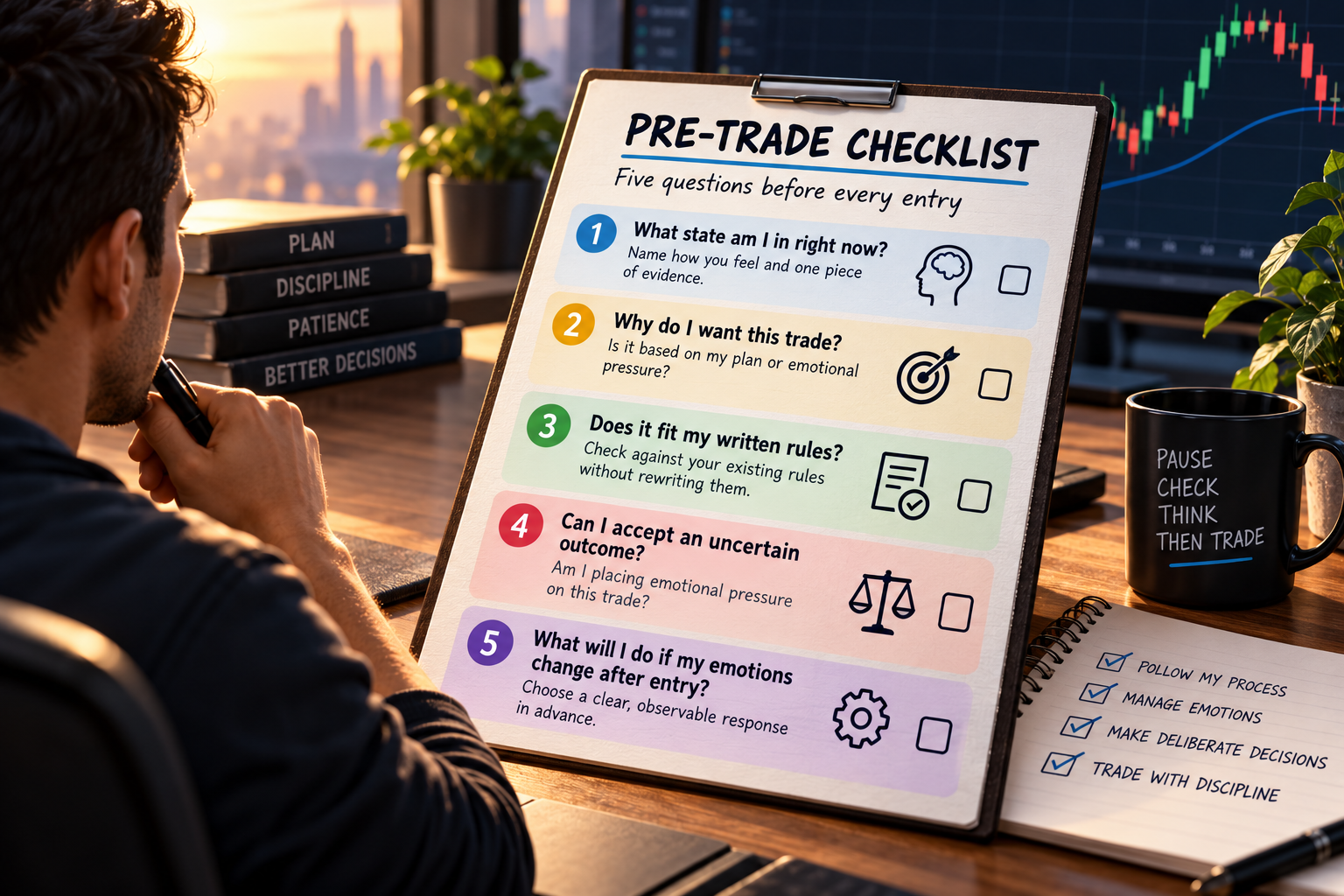
Pre Trade Checklist: 5 Questions Before Every Entry
Before an entry, check more than the setup. These five questions help you notice emotional pressure, recognise rule-bending and make your decision process easier to follow.

How to Improve Trading Psychology: A Practical Guide for Traders
Most trading losses are not caused by a bad strategy — they are caused by what happens between the strategy and the click. This practical guide shows you how to improve your trading psychology with concrete exercises for emotional control, discipline, patience, and self-awareness.