
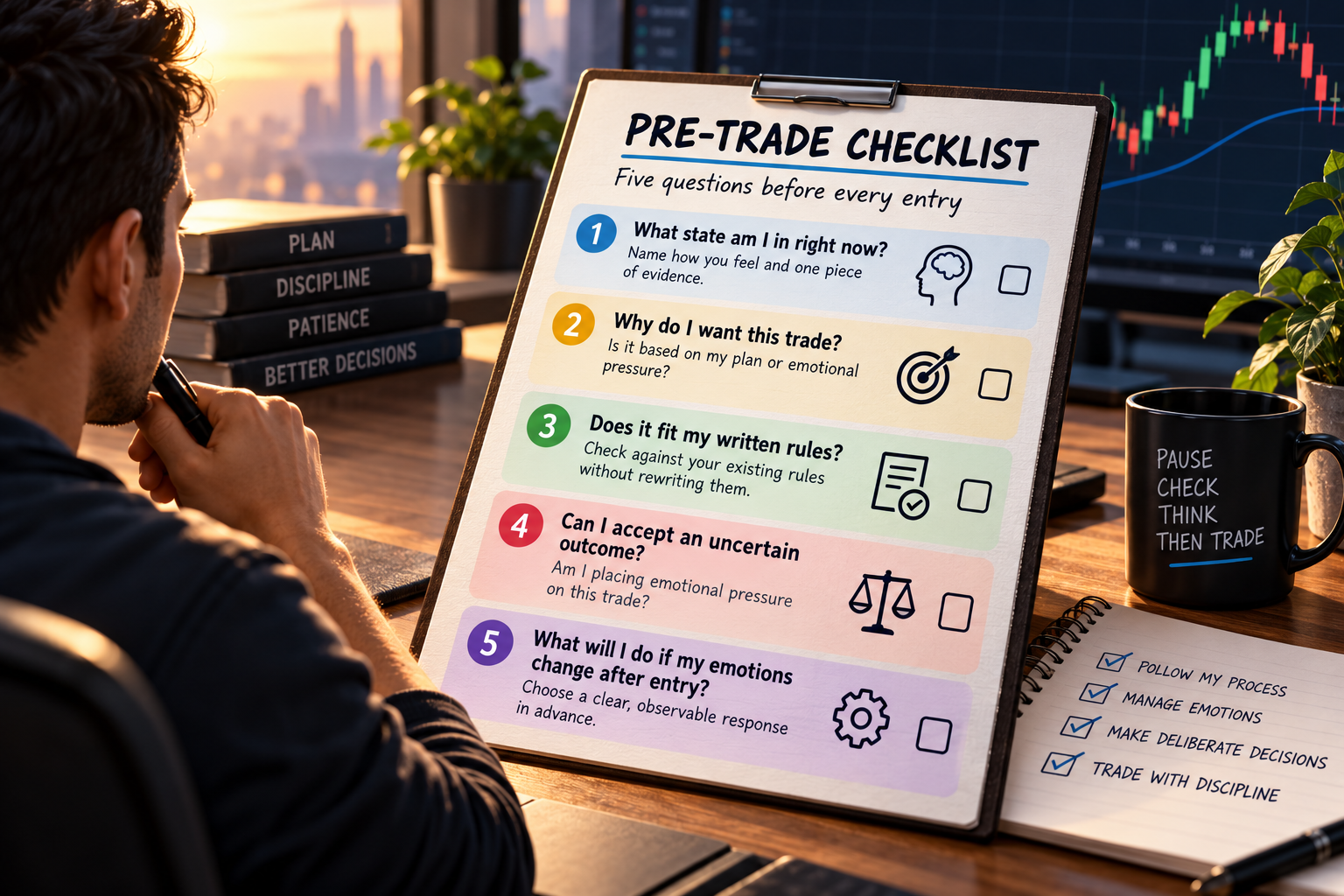
Before an entry, check more than the setup. These five questions help you notice emotional pressure, recognise rule-bending and make your decision process easier to follow.
A pre trade checklist is a short pause before an entry to check whether you are following your plan or reacting to pressure. A useful mental version asks five questions: What state am I in? Why this trade? Does it fit my written rules? Can I accept an uncertain outcome? What will I do if my emotions change?
Answer each question briefly, using observable facts rather than a vague feeling of readiness. If an answer reveals a conflict with your existing rules, treat that as a reason to pause and review—not something to explain away. The checklist supports discipline; it cannot establish whether a trade is suitable or predict its outcome.
What a pre trade checklist should actually check
Your trading plan and your mental checklist have different jobs. The plan defines your approach and boundaries. The checklist helps you notice whether you are in a position to follow them.
You do not need to feel perfectly calm. Nervousness can coexist with deliberate behaviour, while confidence can coexist with impulsiveness. The useful question is whether your current state is changing your decisions.
Keep the check short enough to repeat before each entry. Use the same questions after a win, after a loss and during an uneventful session. Otherwise, it can become something you remember only when you already feel out of control.
Five questions before every entry
1. What state am I in right now?
Name your current state in plain language: settled, tired, distracted, frustrated, excited or anxious. Then identify one piece of evidence.
“I feel fine” tells you little. “I have switched between six charts because nothing feels fast enough” gives you something concrete to examine.
Look for changes in attention and behaviour:
- Are you repeatedly checking your profit and loss?
- Are you rushing because you need to leave soon?
- Are you struggling to describe what you are looking for?
- Has a previous result changed your usual pace?
An emotion alone does not tell you what to do. The warning sign is its effect on your ability to follow your process. If you cannot stay with the question long enough to answer it, pause rather than ticking the box automatically.
2. Why do I want this particular trade?
Complete this sentence: “I am considering this entry because…”
Separate the reason in your plan from the emotional reward you hope the trade will provide. “It matches the conditions I wrote down” is different from “I want to recover the morning's loss” or “I cannot watch another move happen without me.”
Mixed motives are possible. You might recognise a planned condition and also feel a strong urge to get back to break-even. Acknowledging that tension is more useful than insisting your motives are pure.
Ask one follow-up: “Would I still be considering this if my previous trade had ended differently?”
That cannot prove the decision is sound, but it can reveal how much the last result is influencing the next action. If recovery is becoming the main objective, our guide to how to stop revenge trading explores that pattern in more detail.
3. Does this fit my written rules, without rewriting them?
Refer to the rule you already had—not a new explanation assembled while watching the price move.
This is a process check, not a recommendation about entries, instruments or risk levels. Compare the proposed action with the boundaries you chose in advance.
Be alert to phrases such as:
- “This is close enough.”
- “I will make an exception just this once.”
- “The usual rule does not matter today.”
- “I will work out the rest after entering.”
A plan can need revision. But revising it under pressure to accommodate an appealing trade makes it difficult to distinguish learning from rationalisation.
If the rule is too vague to check, record the ambiguity for review outside the immediate decision. Do not count an unclear answer as confirmation that the checklist has been passed.
4. Can I accept an uncertain outcome without needing this trade to fix something?
This question is not asking you to enjoy losses or eliminate fear. It asks whether you are placing an emotional demand on an uncertain event.
Notice statements such as “This one has to work” or “Once I am back to even, I can relax.” They suggest the trade has acquired a second job: repairing your mood, self-image or sense of control.
Consider how you would respond if the outcome disappointed you. Would you still be willing to follow your existing safeguards? Or are you already imagining an immediate attempt to undo the result?
You cannot know exactly how you will feel later. The aim is honest recognition now. If you already intend to abandon your rules after an unwelcome outcome, a completed checklist does not resolve that conflict.
5. What will I do if my emotions change after entry?
Before acting, choose a response to a familiar behavioural warning sign. Keep it within the safeguards already established in your plan.
For example:
- “If I start calculating how quickly I could recover today's loss, I will pause new decisions and use my reset routine.”
- “If I feel an urge to change a rule, I will name the urge before acting on it.”
- “If I catch myself searching for reassurance online, I will return to my written process.”
These are behavioural commitments, not instructions for managing a position. A reset routine should not mean neglecting responsibilities associated with an open trade.
Make the response observable. “Stay disciplined” is an aspiration. “Read my existing safeguard before making another decision” describes an action you can later check.
Make the answers quick, but not automatic
Use one line per question. You are creating a moment of awareness, not writing an essay before every entry.
A reusable note might look like this:
- State and evidence: What am I feeling, and what am I doing?
- Motive: What is drawing me to this trade?
- Rule match: Which existing rule applies? Is anything unclear?
- Outcome pressure: What am I hoping this result will fix?
- Behavioural response: What will I do if a known warning sign appears?
Decide in advance which observations require a pause under your process. That prevents the checklist itself from becoming another set of rules you negotiate in the moment.
Avoid giving yourself a score that lets several reassuring answers cancel out one explicit rule conflict. The purpose is to reveal relevant information, not accumulate enough points to proceed.
Review the process, not just the result
After the session, revisit one or two completed checks. Compare what you wrote with what you actually did.
Did you notice urgency but ignore it? Did a pause help you recognise an unclear rule? Did you follow your process despite feeling uncomfortable?
A profitable result does not prove that bypassing the checklist was sensible. Equally, an unfavourable result does not prove that a careful check was useless. Review whether the questions made your behaviour more visible and your commitments easier to follow.
If the same issue keeps appearing, change one part of your routine rather than adding more questions indefinitely. Our guide to building trading discipline offers practical habits to support that work.
For another starting point, try the free trading psychology test and use it as a prompt for reflection, not a verdict on your readiness to trade.
Join the TradeSthira early access waitlist
TradeSthira is a pre-launch trading psychology and discipline app being built around check-ins before trading, discipline safeguards during, reflection after and behavioural insights over time. It is not a trading-journal-first product and does not provide financial advice, signals or return promises.
If that approach fits what you want to work on, join the TradeSthira early access waitlist.
Related Resources
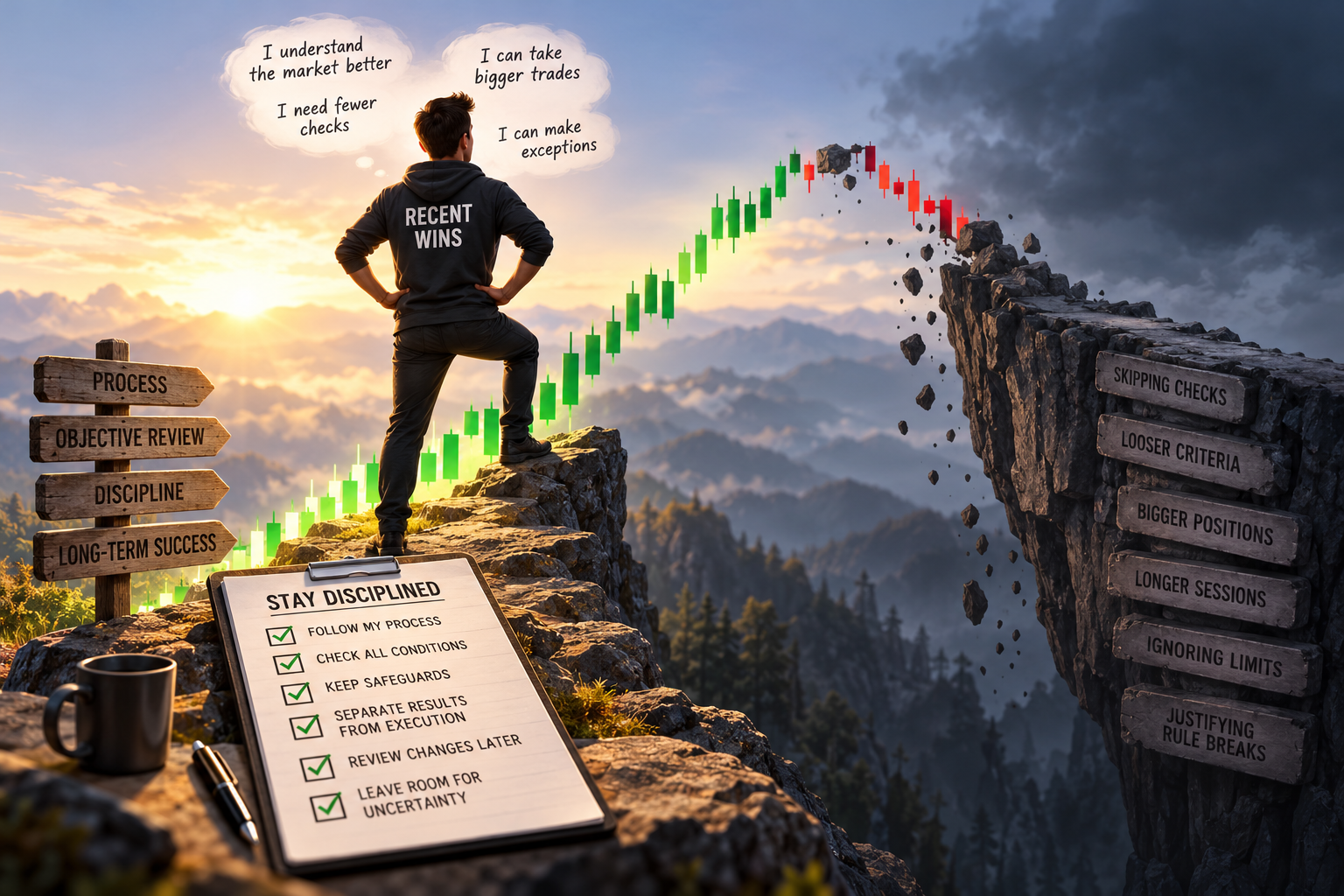
Overconfidence in Trading After a Winning Streak: The Hidden Risk
A winning streak can make your rules feel less necessary precisely when you need them. Learn how to recognise confidence turning into entitlement and keep your process steady.
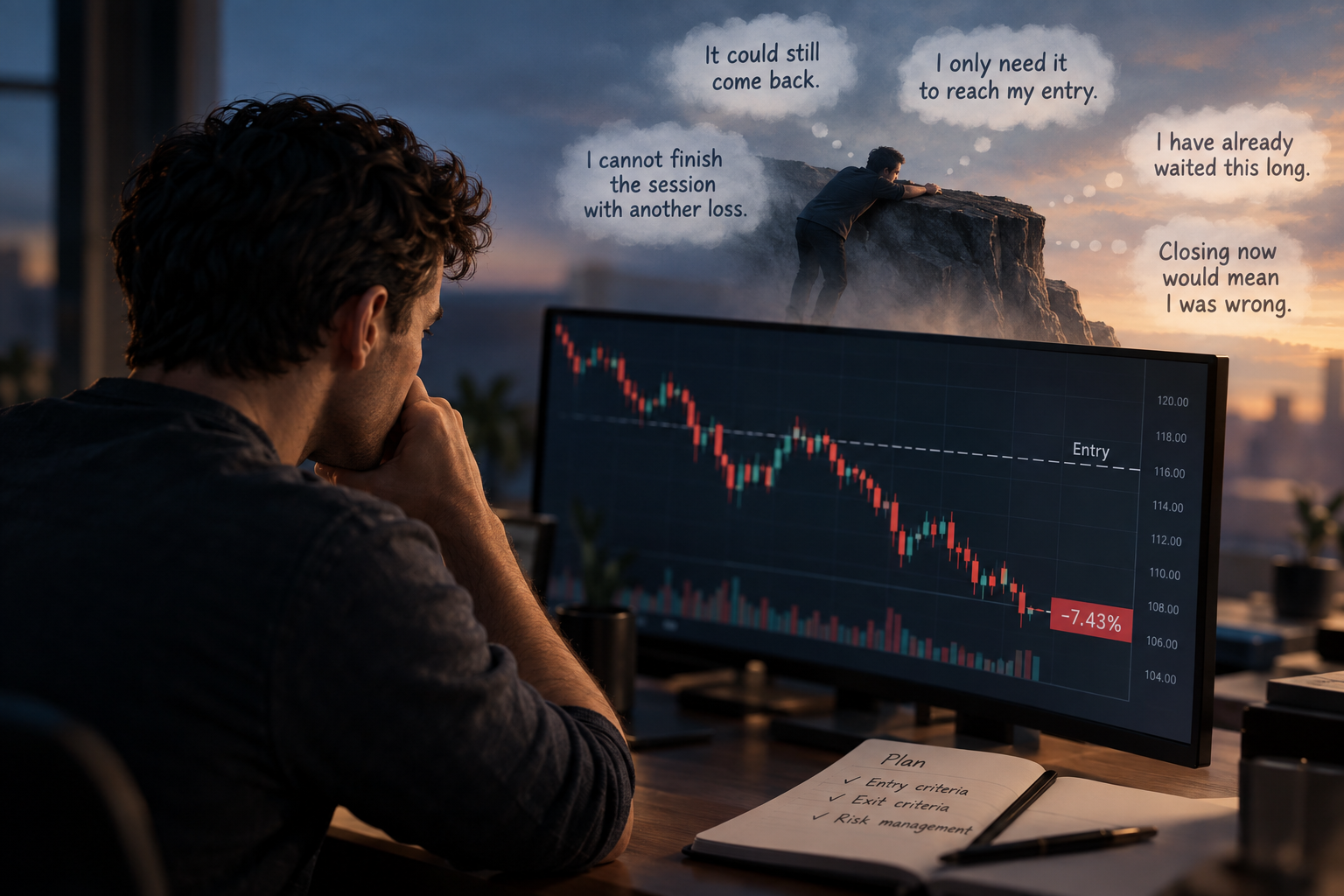
Loss Aversion Trading Traps: Why Holding Losers Feels Safer
Holding a losing trade can preserve hope while postponing the discomfort of accepting a loss. Learn how to recognise that emotional bargain and keep your decision-making anchored to a process.

How to Improve Trading Psychology: A Practical Guide for Traders
Most trading losses are not caused by a bad strategy — they are caused by what happens between the strategy and the click. This practical guide shows you how to improve your trading psychology with concrete exercises for emotional control, discipline, patience, and self-awareness.