
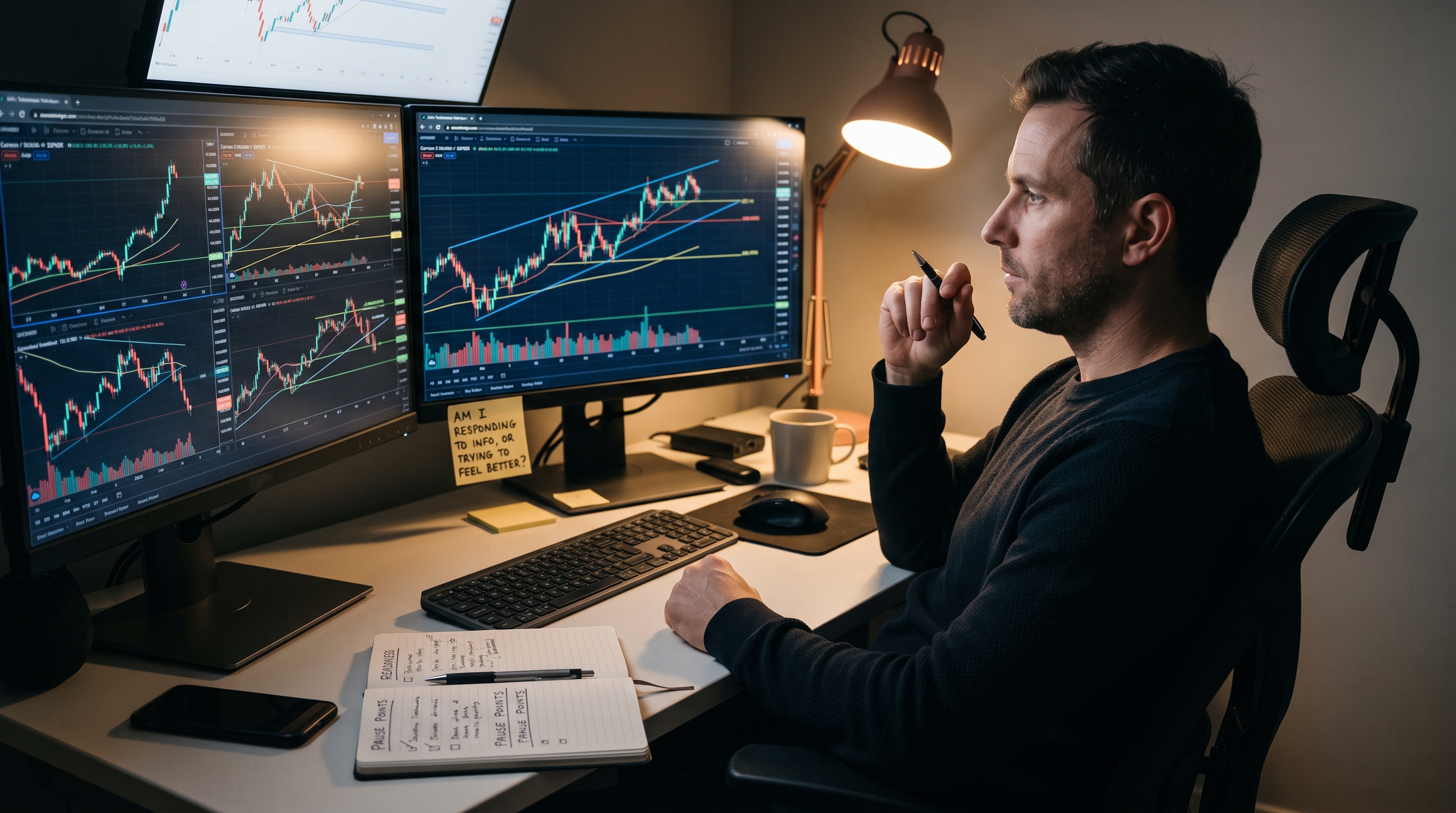
Leverage, fast price moves and near-continuous weekday trading create distinctive psychological pressures. Learn how to recognise those pressures and build boundaries before, during and after trading.
Forex psychology is how your thoughts, emotions and habits influence your decisions when trading currencies. Handling it means recognising how leverage increases emotional pressure, fast price moves create urgency, and near-continuous weekday access makes switching off difficult. The aim is not to eliminate emotion, but to stop it quietly rewriting your rules.
A practical approach is to define your trading window, check your readiness before opening the platform, decide what behaviour requires a pause, and review whether you followed your process afterwards. These habits cannot remove market risk or guarantee results. They can make impulsive decisions easier to notice before they become repeated patterns.
Why forex psychology needs clear boundaries
Forex markets generally operate around the clock during the working week, although availability varies by instrument and broker. That access can create the impression that you should always be watching. Meanwhile, leverage can make relatively small price movements feel personally significant.
The pressure often follows a loop:
- A price move or loss creates discomfort.
- You interpret that discomfort as a reason to act.
- Acting briefly relieves the feeling.
- That relief reinforces the habit, regardless of the eventual result.
For example, reopening your platform after deciding to finish may ease the fear of missing out. That does not mean reopening was a considered decision.
A useful first question is: “Am I responding to information, or trying to change how I feel?” Sometimes both are involved. Naming the emotional part gives you something concrete to manage.
Leverage: separate market movement from emotional pressure
Leverage magnifies the financial effect of price changes relative to the capital committed. It can also magnify the attention you give every movement. A routine fluctuation may suddenly feel like a threat, an opportunity to recover, or a verdict on your ability.
That can show up as repeated profit-and-loss checks, bargaining with your original plan, or mentally spending an unrealised gain.
Notice the behavioural change
Rather than asking whether you are a naturally calm person, ask what happens once exposure is live:
- Do you keep checking the same position without receiving useful new information?
- Do you start changing rules you accepted before entering?
- Does the outcome feel connected to your self-worth or financial worries?
- Are you hiding your discomfort by calling it confidence?
These observations are not instructions about position size or whether to trade. They are signs that emotional pressure may be interfering with your process.
When they appear, use a pause procedure agreed in advance rather than inventing a new rule while activated. Any live exposure still needs to be handled under your existing risk procedures; pausing new decisions is not the same as ignoring open positions.
Speed: interrupt urgency without demanding perfect calm
Rapid moves can compress the space between noticing something and clicking. Scheduled economic announcements, unexpected headlines and changing liquidity can all make the market feel harder to follow. The psychological trap is assuming that speed creates an obligation to participate.
You may hear yourself thinking, “It is moving now, so I cannot wait.” That is a description of urgency, not proof that a decision fits your plan.
Use a brief decision checkpoint
Before an unplanned action, ask:
- What changed in the market, in plain language?
- Which part of my existing plan covers this decision?
- Would I consider it if I had not just seen that sudden move?
If you cannot answer, label the situation “urgency without clarity”. The label helps distinguish an emotional demand from a planned response.
The checkpoint belongs before a discretionary action, not in place of time-sensitive risk management. Its purpose is to interrupt impulsive entries, additional trades or unnecessary changes—not delay an established protective procedure.
Weekday access: make availability different from permission
A market being open does not mean you are psychologically available to trade it. Sleep, work, family commitments and attention remain limited, even when charts are accessible.
Without a defined stopping point, “one last check” can become another hour of monitoring. A missed move during one session may become a reason to watch the next, extending the day far beyond what you intended.
Define the end before the beginning
Create a boundary that answers three questions:
- When does my planned decision-making window end?
- What must be checked or completed before I close the platform?
- What will I do if I feel tempted to reopen it?
Your shutdown routine might include confirming that existing positions are being managed according to your plan, writing one sentence about your state, and silencing non-essential market notifications.
Also watch for displaced fatigue. Feeling flat after work does not always look like tiredness; it may appear as impatience, boredom or a need for stimulation. Those states deserve a readiness check, not automatic platform access.
After a loss: avoid turning discomfort into a recovery mission
A loss can narrow attention around one objective: getting back to where you were. In forex, the ability to switch pairs or keep trading into another session can make that mission easy to extend.
Changing the instrument does not necessarily change the motive. A trade in a different currency pair can still be an attempt to undo the emotional impact of the previous one.
Notice recovery language such as:
- “I just need one decent trade.”
- “I cannot finish the day like this.”
- “This next one will make up for it.”
Treat these phrases as cues to use your predetermined interruption rule. For a closer look at that pattern, read How to Stop Revenge Trading.
Build a before, during and after routine
A useful routine should be short enough to use on an ordinary day, not just when you feel motivated.
Before: check readiness, not enthusiasm
Write a brief answer to each prompt:
- What is my energy and attention like today?
- Am I carrying frustration from an earlier result?
- What behaviour would tell me I need a pause?
Make the last answer observable. “When I am emotional” is vague. “When I start searching for another trade immediately after a loss” is easier to recognise.
During: monitor rule drift
Look for changes in behaviour rather than checking whether you feel good. Repeatedly revising your rationale, extending your session or dismissing a previously important safeguard can all signal rule drift.
A simple if–then statement helps: “If I catch myself inventing a reason to bypass a rule, then I stop initiating new trades and use my planned review procedure.”
For broader habit-building ideas, see How to Build Trading Discipline.
After: separate process from outcome
A profitable outcome does not prove that an impulsive decision was sound. A losing outcome does not automatically mean that you lacked discipline.
Record four things: the trigger, your emotional state, the action you took, and whether it matched your plan. Then choose one small adjustment for the next session. Over time, this can reveal patterns that profit-and-loss figures alone do not explain.
If you are unsure which habits to examine first, use the free trading psychology test as a starting point for reflection, not a diagnosis or prediction of trading success.
Explore TradeSthira early access
TradeSthira is a pre-launch trading psychology and discipline app being built around pre-trade check-ins, discipline safeguards during trading, post-trade reflection and behavioural insights over time. It is not a trading-journal-first product and does not provide financial advice, signals or return promises.
If that approach fits what you want to work on, join the TradeSthira early access waitlist.
Related Resources

Market Psychology vs Your Psychology: Why Crowd Emotion Pulls You In
Crowd emotion can make someone else’s urgency feel like your own conviction. Learn to separate market narratives from your internal response, with practical checks before, during and after trading.

How to Improve Trading Psychology: A Practical Guide for Traders
Most trading losses are not caused by a bad strategy — they are caused by what happens between the strategy and the click. This practical guide shows you how to improve your trading psychology with concrete exercises for emotional control, discipline, patience, and self-awareness.
How to Stop Revenge Trading: A Practical Guide for Traders
Revenge trading can turn one manageable loss into a damaging trading session. Learn how to recognise the warning signs, interrupt the cycle and build a more disciplined response to losing trades.